
5 creative AI activities to do with your kids today
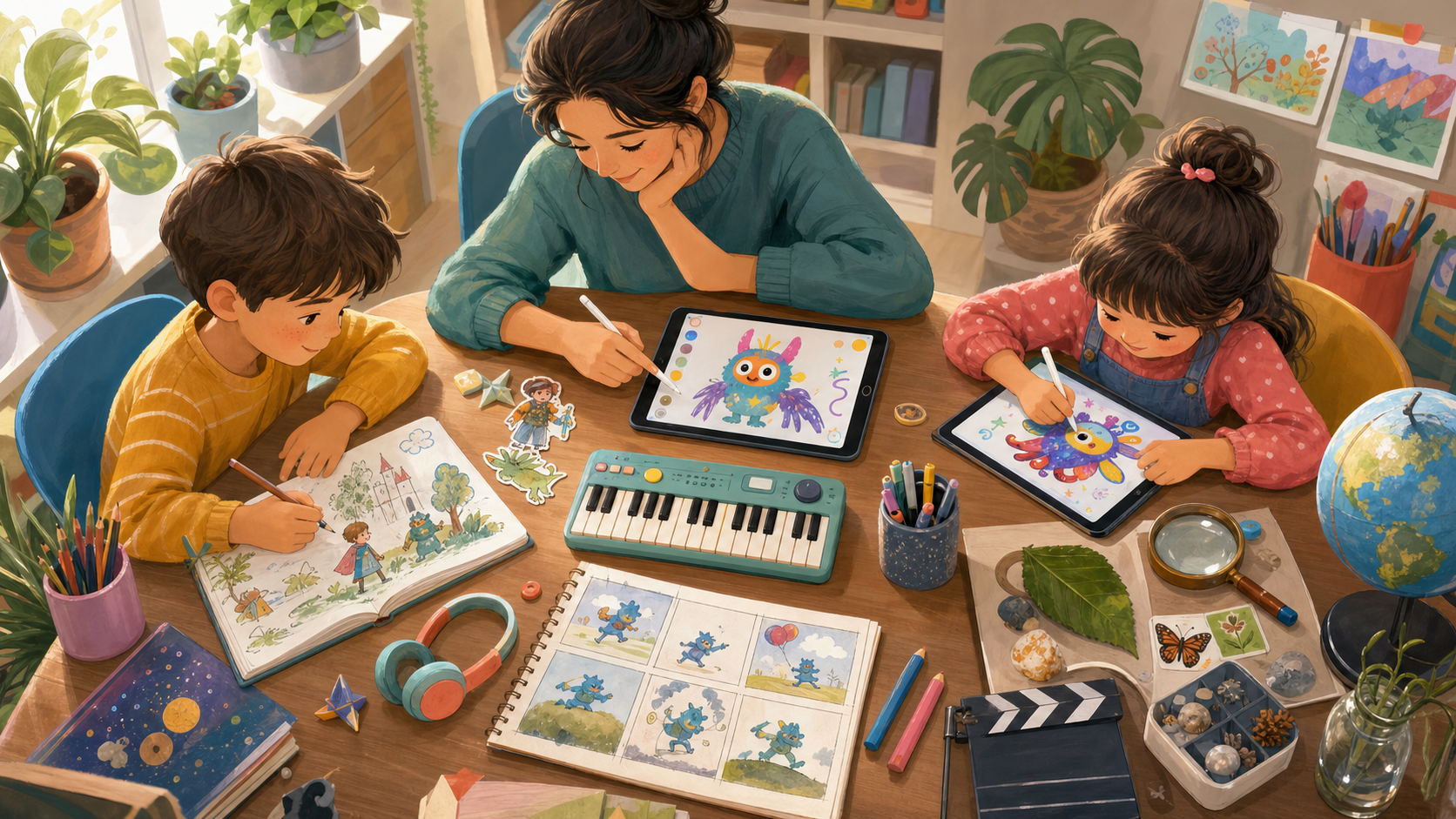
Does your child always say "I'm bored"? Or maybe you're both at home and looking for something genuinely creative to do together? Creative AI activities for kids have opened up a whole world of possibilities — and the best part is they take minutes, not hours of preparation. No special equipment required: just a connection and the will to create.
In this article, we share 5 practical activities that any family can start today. Each one is designed for children aged 6 to 12, but parents and caregivers enjoy the experience just as much.
1. Create an original story
One of the most magical ways to explore AI is to let it become the stage for a child's imagination. You and your child can build a story from scratch: they start with an idea ("an astronaut who finds a magic planet") and the AI helps expand the narrative with characters, plot twists, and engaging dialogue.
The process is simple and highly engaging:
- 1Open the NanoKoala storytelling lab
- 2Ask your child to describe the main character with fun details
- 3The AI generates passages that your child can refine, rewrite, or expand
- 4Within minutes, you have a complete story to read aloud at bedtime
What makes this activity special is that the child remains in control. The AI doesn't "write the story for them" — it offers ideas that are chosen, rejected, or adapted. It's shared creativity, not replaced creativity. The result? A story that belongs 100% to the child's imagination.
2. Draw an imaginary character
Children have incredible ideas in their heads but don't always manage to transfer them to paper. AI image generation changes that completely. Your child can describe a detailed character — "a dragon with purple wings, a pirate hat, and scientist glasses" — and see the illustration generated in seconds.
The result of this activity can become:
- ✓A page to colour after printing
- ✓Inspiration for drawing by hand with more confidence
- ✓The central character of an imaginative game you create together
From there, conversation flows naturally: "Why does he wear a pirate hat? What's his name? What powers does he have?" Drawings generate stories, stories generate more creativity — a virtuous cycle that builds vocabulary and narrative thinking.
3. Compose a song about the day
Not every child takes music lessons, but every child has rhythm and a voice. AI can help them compose a short song about their day, their best friend, or a weekend outing. It's a fun and accessible way to explore rhyme, melody, and emotion — even without ever having learned music theory.
Here's how to start:
- 1Talk about the topic together ("let's make a song about our trip to the park")
- 2Decide on the rhythm together ("fast and happy" or "slow and mysterious"?)
- 3The AI generates verses and a chorus for you
- 4Sing together — or laugh at the results, that counts too!
Many children who try this activity discover they love rhyming and writing lyrics — and some even ask to learn more about real composition. It's a gentle gateway into the musical world that few resources can offer so naturally.
4. Animate a short scene
Animation may seem complicated, but with AI it becomes accessible to any age. Your child can imagine a simple scene — "a colourful butterfly flying over a blooming garden" — and watch that idea come to life in motion. Seeing their own creation move on screen is thrilling and highly motivating.
This activity opens doors to deeper experiences:
- ✓Tell stories using sequences of animation
- ✓Build a creative portfolio to share with family
- ✓Discover that technology and art can go hand in hand
At NanoKoala, the animation lab was designed exactly for this — simple activities that produce impressive visual results, genuinely made by the child.
5. Explore a school topic with AI
Does your child have a project on animals, plants, history, or science? AI can make research far more interactive and enjoyable. Instead of opening five different websites and copying text, you can explore the topic visually and collaboratively.
Some practical examples of what you can do:
- ✓"What are the fastest animals in the world?" → the AI explains and illustrates
- ✓"What did a Roman house look like?" → detailed description and a generated image
- ✓"What flowers grow in spring?" → a list with a visual gallery created by AI
The child learns and creates at the same time. School work stops being a boring chore and becomes a creative project they're proud to present. This may be AI's greatest power in education: turning passive research into active creation.
Why these activities work: they are child-led (the child controls the direction), they produce something tangible (a story, a drawing, a song), they spark conversations between parents and children, and they're fun — no pressure, no right or wrong.
How to start right now
You don't need to wait for the weekend. Choose one of the 5 activities above and start today. Ten minutes, one idea, and a curious child are all you need to take the first step. For more ideas on integrating AI into your family routine, also check out our complete guide to AI for kids and tips for parents who want to guide the process safely.
If you'd like to explore all these activities in one safe, supervised place, NanoKoala's labs offer guided creativity with AI — with moderation and the reassurance of knowing your child is creating, not just consuming.