
AI in early childhood education: how it can help the teacher
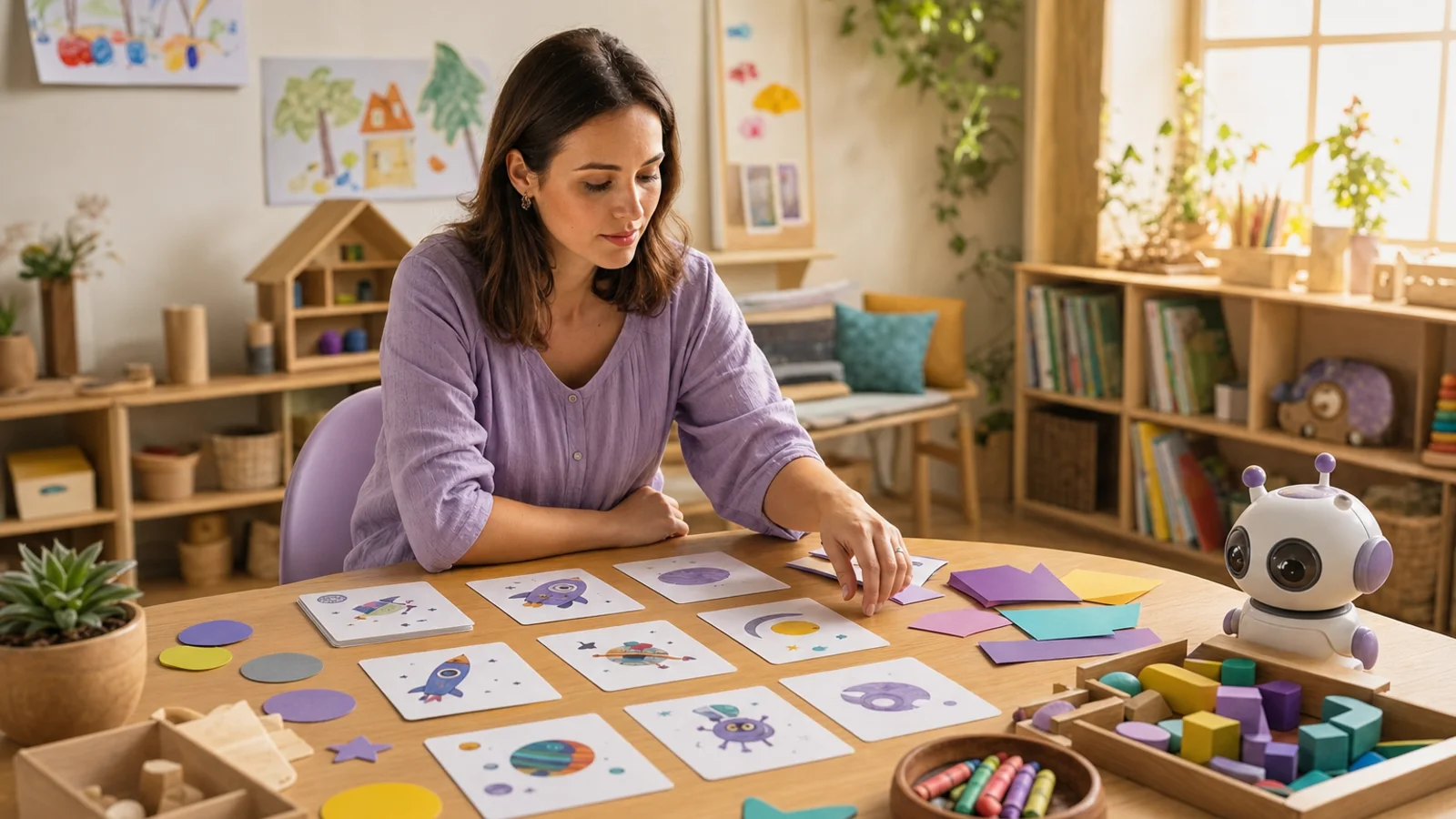
Few topics divide a staff room quite like artificial intelligence. For some, it promises relief from an unbearable workload; for others, it is one more novelty arriving before any proper training. Both reactions are legitimate — and the truth, as so often in education, lies in the middle.
This text is neither a manifesto for nor against. It is an honest attempt to look at where AI in early childhood education really helps the teacher, where it gets in the way, and how to take the first steps without giving up what makes teaching irreplaceable: the human relationship.
What using AI in early childhood education really means
When people talk about "AI in the classroom", the image many picture is a child alone in front of a screen, chatting with a robot. That scenario exists, but it is far from the most common one — and rarely the most useful.
In early childhood education, the most mature use of AI almost always happens behind the scenes: it is the teacher who turns to a tool to prepare an activity faster, adapt material for a specific child, or organise records that used to take hours. The child often does not even notice that AI is involved — and that is perfectly fine.
It is worth separating two uses that are often confused:
- ✓AI as support for the teacher. Planning, adapting, summarising, generating variations of an exercise. The adult stays in charge and filters everything before it reaches the child.
- ✓AI as a tool for the child. Activities where the pupil interacts directly — always inside a closed, supervised environment suited to their age.
The first use is where most of the real gain happens today. The second demands far more caution — and we will come back to it.
Where AI really helps the teacher
Setting aside the hype around new releases, the most concrete benefit of AI for anyone who teaches is prosaic: time. And time, for an early childhood teacher, is the scarcest currency there is.
- ✓Faster planning. Generating a first draft of a lesson plan, a list of variations of the same activity, or ideas for a specific theme. The teacher edits and adapts — but starts from something rather than a blank page.
- ✓Personalisation. Adapting the same content for different levels in a mixed class, or for a child with specific needs, without rewriting everything from scratch.
- ✓Administrative tasks. Summarising observations, organising progress reports, drafting messages to families. It is the kind of invisible work that steals the time that should go to the children.
- ✓Inclusion. Generating simplified versions, translating materials for families who speak another language, creating visual supports for children who cannot read yet.
The criterion that organises everything: AI is good at what is repetitive, mechanical, or a first draft. It is weak — and sometimes dangerous — at anything that requires judgement about a real child. The boundary between the two is exactly what the teacher must not delegate.
Four low-risk ways to start experimenting
You do not need to overhaul your routine to try it out. A few low-risk entry points:
The limits: what AI should not do
An honest text about AI in early childhood education must devote as much space to the risks as to the benefits. Young children are, by definition, a vulnerable group — and some lines should not be crossed.
- !Assessing a child in the teacher's place. No model sees the context, the history and the subtle signals an educator perceives. Diagnosis and pedagogical judgement are human.
- !Replacing the bond. Learning, at this age, is deeply relational. A screen does not regulate emotion, does not comfort a crying child, does not notice when something is wrong at home.
- !Collecting data carelessly. Information about children demands rigour with privacy. It is worth checking what the tool stores and whether it complies with data-protection law before entering any real data.
- !Operating without supervision. Every direct interaction between a child and AI must take place in a closed, moderated environment — never with open, generative tools built for adults.
There is also a less visible risk: dependency. A tool that delivers everything ready-made can, over time, atrophy exactly what school should strengthen — the ability of the child (and of the teacher) to think from scratch. Good use of AI preserves cognitive effort; bad use outsources it.
How to start small
For anyone who wants to experiment without turning their routine upside down, a gradual path works better than a big reform:
- Pick a single pain point. Start with the task that eats up the most of your time outside the classroom — usually planning or communication with families. Solve one thing at a time.
- Use AI only behind the scenes at first. Before bringing any tool to the children, build confidence by using it for your own work. You come to understand the limits in practice.
- Always review. Treat any result as an intern's draft, never as final truth. The teacher's eye is the quality control.
- Agree on rules with the team and families. Transparency prevents distrust. Say what is used, how, and for what purpose — especially when children's data is involved.
If you want to understand the broader context before bringing the topic to your team, our overview of AI for children: what it is, benefits and how to start is worth a read.
Frequently asked questions
Will AI replace the early childhood teacher?
There is no realistic sign of that. The core of the work at this stage — the bond, mediating conflicts, reading a child's emotions — is exactly what AI does not do. What may change is the bureaucratic, repetitive part, freeing the teacher for what only they can do.
From what age does it make sense for a child to interact directly with AI?
There is no magic number, but there is a principle: the younger the child, the more AI should stay behind the scenes, at the adult's service. When there is direct interaction, it must happen in a closed, supervised environment designed for that age group — never in open tools.
What about the privacy of children's data?
It is the most sensitive point. Before using any tool, check what it collects, where it stores it, and whether it complies with data-protection law. As a rule of thumb, avoid entering real children's data into services that do not offer clear protection guarantees.
Do I need to know about technology to use AI in the classroom?
No. The most useful tools today work with everyday language — you describe what you need and adjust the result. What makes the difference is not technical mastery, but the pedagogical judgement to assess what worked and what did not.